Mar 23, 2020

Historical Fiction Annotation


Last Train to Istanbul Image result for last train to istanbul
by Ayse Kulin
Publisher: Everest Publications, Istanbul (Aug. 2006)
Format: Paperback, 414 pages
Geographical Setting: Turkey and France
Time Period: 1933 through 1943
Summary:
"Is there some corner of this vast world where people live without tormenting each other?"

Newly married Selva (a Muslim) and her husband, Rafael (a Jew), leave Istanbul for Paris in the hope of a better life.  However, they didn’t anticipate a few years later the Vichy government would be collaborating with Hitler. As the Gestapo start rounding up Jews, Selva finds a way to help them escape until Raphael too is captured.  With the help of her brother-in-law (undersecretary for the Turkish Foreign Minister) in Ankara and his colleagues at the Turkish Consuls in Paris and Marseilles, they are able to free Rafael. With help from the French Resistance movement, a plan is established to have a ‘special’ train transport the Turkish Jews (and others with forged papers) back to Istanbul.

Turkey dangerously plays a political game with the Axis and Allies while trying to maintain its neutrality during the war.
Elements of a Historical Romance:
Story Line: The author decided to focus her novel on an important yet forgotten story.  One of the heroic efforts of Turkish diplomats and a young Turk in the French Resistance attempt to rescue the Jews from France during WWII.  She “explains and contextualizes events, linking them to the settings of the period and to particular characters and their motivations” (p. 172).

Pacing: The story isn’t fast paced as it takes place over a ten year span from the point of view of two sisters, their families, other families, and various diplomatic figures and resistance fighters.  Each of these characters has a “detailed background” (p. 172). Due to the nature of the story, the pace starts off slow, but picks up once Rafael is captured and Selva finally agrees to leave France for Istanbul.

Tone: Being set in the 1930’s and WWII, the novel is grim and somber, but full of anticipation waiting to see if the characters will escape to Istanbul or be sent to the camps after being caught by the Gestapo.  Various meetings between Inonu, Von Papen, de Gaulle, Churchill, Roosevelt and other leading diplomats of the time were serious and ‘threatening’. Descriptions of life at the camp David is sent to are dark and harsh.

Frame/Setting: Full of ‘accurate historical detail’, the author describes the political events in Turkey and France and the people it affected from 1933 to 1943.  The various societies (Turkish, French, German, Hungarian) and their religious beliefs, customs, and cultures are also historically accurate. The geographical descriptions are detailed as the author takes us back and forth from Istanbul and Ankara to Paris and Marseilles with brief stops in Lyon and Cairo.  The author uses authentic correspondence and archives to back up her narratives and has a short bibliography of other Turkish resources.

Historical Fiction Read-A-Likes:
Fiction:
All the Light There Was by Nancy Kricorian
Once Night Falls by Ronald Merullo
Schindler’s List by Thomas Keneally
NonFiction:
Turkey and the Rescue of Jews during the Nazi Era dissertation by I. Izzet Bahar
Turkey and the Holocaust by Stanford J. Shaw
The Jews of the Ottoman Empire and Turkish Republic by Stanford J. Shaw

Works Cited:
Saricks, J. G. (2019). The readers’ advisory guide to genre fiction. Chicago: ALA.

Mar 11, 2020

Book Club Experience

I decided to try my library’s ‘Books on Tap Book Club’.  This was my first experience with any type of ‘outside’ book club that wasn’t with people I already knew or was comfortable with.  I must say that I really enjoyed myself. The group was very friendly and open and welcomed me right away. I did introduce myself and let them know I was attending as a MLIS student and I would be listening, observing, and taking notes so they didn’t think it was odd when I pulled out my notebook and pencil.  (At one point another patron not part of the club mentioned that I was ‘really prepared’ because she saw me taking notes diligently.) However, I did ask if I could chime in on the topic since it was one that greatly interested me and they later encouraged me to join in on the conversations.

‘Books on Tap’ is a monthly club held at Bru Burger every 2nd Tuesday from 6:30-8 pm.  Appetizers are provided, but anything else is paid for by the individual members. This club is category based so every month a different genre is discussed (February - romance or romantic thriller; April - comedy; May - military history).  One very unique aspect I found about this club is that there is no assigned book. The members chose what they want to read as long as it pertains to the genre of that month. (Two of the members did tell me that is not strictly adhered to all the time but nobody seems to mind.)  In the instance where a book is read by more than one member (as in this time) then they just compliment each other and fill in what the other left out. With this being National Women’s Month the topic for this discussion was any woman from history. The other unique aspect I found was that anyone could join even if they hadn't read a book.  I really liked this concept and it made me feel even more comfortable joining the club.

As the group got started, two women were leaving the restaurant and stopped when they saw the books on the table.  They became very interested and asked details about the club. Lauren, the librarian and facilitator, answered and gave more details.  She was interrupted a few times by another group member who wanted to answer the ladies’ questions. Both genuinely seemed interested and got all the details for the next meeting.  Some of the books that were to be discussed at this meeting were already read by them.

The group consisted of eight women (including Lauren, but not me) and one man.  Except for Lauren and myself, all the attendees would be considered from the Baby Boomer generation as many talked about the times of their parents and grandparents when discussing the novels.  I later found out that one more man attended previous meetings but no longer could because of timing conflicts with work. The ladies missed the other gentleman and his take on the novels that had been discussed while he was an attendee.  One by one they went around the table discussing the book they read (like a book report format); if they brought the book it was usually passed around.  The majority of the attendees had completed their book, a few were in the process. Questions were asked throughout and many led to tangent discussions - some on topic, some off topic - at which point Lauren had to bring the group back on topic.  Many of the questions were very in depth and there was a sense that the attendees wanted to learn more about the woman in question. It was mentioned by several that this month’s topic led to the liveliest group discussions thus far. After the first few books were discussed, Lauren mentioned recurring themes - gender issues, then and now (how these and other women were treated by men) and women empowerment and how it evolved over the years. This led to several discussions on the Suffragettes Movement and how long it took from its start to the 19th Amendment, how these attendees grew up and compared it to their mothers and grandmothers and today’s generation of women, and somehow on the McCarthy Era.  The sole gentleman in the group was praised by many of the other women because they considered him a ‘feminist’ from his previous comments from previous book discussions. He did ask two very relevant questions in between the various book discussions: (1) Do you go into reading a book written by women about women with skepticism? and (2) What do you do after reading/hearing about these important women?  Both questions were answered by the two women sitting on either side of him (one being Lauren). The responses to the first question was that she was always skeptical about every author she read, be it man or women; however, the other answered that she was not skeptical, but she had to ‘trust and verify’ what she read.  The responses to the second questions was that she would tell anyone she could about the books so they could read it as well and the other said that she saw herself in these strong and independent women.

The books that were discussed in this month’s club meeting were:
  • Hedy’s Folly: The Life and Breakthrough Inventions of Hedy Lamarr, The Most Beautiful Woman in the World by Richard Rhodes
  • The Only Woman in the Room by Marie Benedict (coincidently also about Hedy Lamarr and read by another club member)
  • Fly Girls: How Five Daring Women Defied all Odds and Made Aviation History by Keith O’Brien
  • Lady Clementine by Marie Benedict (Churchill’s wife)
  • Varina by Charles Frazier (Jefferson Davis’s second wife)
  • Head Strong: 52 Women Who Changed Science - and the World by Rachel Swaby
  • Diamond Doris: The True Story of the World's Most Notorious Jewel Thief by Doris Payne
  • A book about Queen Elizabeth I of England
  • A book about Eleanor Roosevelt

As these books were being discussed, one attendee mentioned she started to read about Julie Andrews but found the book too dry and had to stop.  The attendee who read Lady Clementine said it was a good story but she didn't like her as a person.  She then read Varina which was sad because it showed how not only Blacks were subjugated as slaves but women as well with trying to keep them calm with laudanum or putting them in asylums.  In Head Strong ‘the women were fascinating, but not the book’, so it was suggested maybe the audio version would be better.  Diamond Doris, although an autobiography, ‘was an easy and fast read, like fiction’.  This book had lots of feedback as the group got to know more about her. Out of all the women discussed, she’s the only one still alive with an upcoming Hollywood movie release.

The overall atmosphere of the evening was very warm and friendly.  At the end, all the members asked me to return next month. The group members knew each other very well and some for several years which made it easy for all of them to actively participate.  No one really took over the discussion; there was some over talk and off topic discussions which Lauren had to bring back, but no one took offense the few times she had to. It was nice to be at a club meeting that started and ended on time.  I really enjoyed myself, the topic, the ambience, and the club members.

Mar 5, 2020

Special Topics - Promoting Muslim Authors and Awards

Compared to mainstream literary awards, such as the Pulitzer, Newberry, National, Hugo, Guardian and Nobel (just to name a few), Muslim literary awards is a fairly new concept.  I researched five literary awards (one was an academic award so will not be in this summary) pertaining specifically to Muslim authors and provide a brief history of each. I then compared these to GoodReads and found that many of the authors and their books had been either nominated or awarded a GoodReads Choice Award in their various genres. I concluded my paper with a few ideas on how libraries can promote these books and authors to all readers, not just those of the the same diverse background.
  • The Arab American Book Award (AABA) was established in 2006 by the Arab American National Museum in Dearborn “to inspire authors, educate readers and foster a respect for and understanding of Arab American culture {by recognizing} books written by and about Arab Americans” (AABA website).  Winners and honorable mentions are presented annually in the following five categories: Academic Adult Non-Fiction, Creative Adult Non-Fiction, Adult Fiction, Poetry, and Fiction or Non-Fiction Children/Young Adult.
  • The Middle East Book Award (MEBA) was created in 1999 by the Middle East Outreach Council “to recognize books for children and young adults that contribute meaningfully to understanding of the Middle East” (MEBA Website). The primary difference between the MEBA and AABA is that  authors do not have to be Arab Americans. Winners and honorable mentions are presented annually in the following three categories: Picture Books, Youth Literature, and Youth Non-Fiction.
  • Daybreak Press, associated with Rabata, “provides a platform for women writers in a variety of literary genres and academic fields, by publishing and promoting work that encourages positive cultural change” (Rabata Website). The Daybreak Book Awards was established annually to recognize their individual and important work in up to twenty-seven categories.  A few of the 2019 awards were given in the following categories: Poetry, Picture Book, Book Series, Activity Books, Non-Fiction Islamic, Non-Fiction, Non-Fiction Biography/Memoir, YA Fiction, Islamic Fiction, Best Cover Design, and Best Illustrations.
  • The Asian/Pacific American Award for Literature (APAAL) was established by the Asian/Pacific American Libraries Association (APALA) in 2001 “to honor and recognize individual works of Asian/Pacific American experiences (either historical or contemporary) or Asian/Pacific American cultures by Asian/Pacific Islander American authors and illustrators” (APALA Website).  The award is given in one of five genres: Adult Fiction/ Graphic Novel, Adult Non-Fiction, Picture Books, Children’s Literature, or Young Adult Literature.
There have been so many books published just within the past five years written by (mostly) young Muslim authors, coincidentally the majority of them being women, born and raised in either Canada or the United States.  With March being Women’s History Month, this is the perfect opportunity for libraries to promote these novels in their various genres - Adult Fiction, Romance, Fantasy, YA, Children’s, and Picture Books, just to name the most popular.  This year, International Women’s Day is March 8 and for this libraries should display books written by Muslim women authors from other countries. Since this day is falling on a Sunday, libraries should consider having the display for a few days, not just the one, to garner more publicity.  In 2017, March 27 was declared Muslim Women’s Day and since then has been become a strong online movement (Lyons, Bustle; Scott, CNN).  This year, Muslim Women’s Day falls on the last Friday of the month, so libraries should have their displays promoting Muslim women authors from then until the end of the month.  Throughout the month posters, flyers, banners, and bookmarks should be placed at strategic locations within the library. In the various sections/rooms, such as the main circulation desk, children's room and tween/teen areas, pertinent posters, flyers, banners, and bookmarks should be displayed promoting books and authors of their respective ages.  At every checkout, a bookmark should be placed with the return slip. The library website should have a banner promoting the month with a slide show of the various books and the library program catalog should also have a page promoting the month. FaceBook and Twitter should be used to promote the books and any programming during this month If possible, the library should try to get an author to speak about her book. An author who has written in multiple genres for different ages would be the best way to promote this growing niche.

Works Cited:
Arab American National Museum. (2020). Arab American Book Award. Retrieved from
http://www.arabamericanmuseum.org/bookaward

Asian/Pacific American Libraries Association. (2020). Literature Award Guidelines & Nominations.
Retrieved from http://www.apalaweb.org/awards/literature-awards/literature-award-guidelines/

Lyons, Joseph D.  (March 26, 2018). Why is March 27 Muslim Women’s Day?  Bustle.
Retrieved from https://www.bustle.com/p/why-is-march-27-muslim-womens-day-the-date-celebrates-
this-marginalized- community-8603055

Middle East Outreach Council.  (2018). Middle East Book Award.  Retrieved from
http://www.meoc.us/book-awards.html

Rabata.  (2019). Daybreak Press.  Retrieved from https://www.rabata.org/daybreakpress/

Scott, Katy. (March 26, 2018).  Why Amani Al-Khatahbeh created Muslim Women’s Day.  CNN.
Retrieved from https://www.cnn.com/2018/03/26/middleeast/muslim-girl-amani-al-khatahtbeh/index.html


Image result for ms. marvel by g. willow wilson               Image result for samira ahmed books.           22249766

Image result for curious george ramadan book.     

Feb 29, 2020

Women's Lives and Relationship Annotation

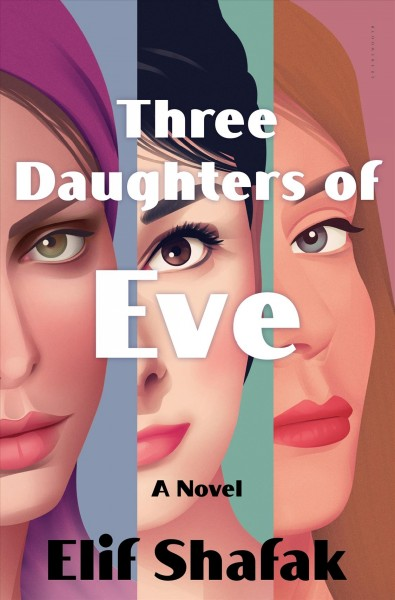
Three Daughters of Eve
by Elif Shafak
Publisher: Bloomsbury New York (Dec. 2017); Hardback, 369 pages.
Geographical Setting: Istanbul and Oxford University; Time Period: 1980s to the present day (2016)

Summary:
Over the course of a few hours in modern Istanbul at a luxurious dinner party, Peri is reminded of her childhood in another part Istanbul and college years at Oxford.  There she befriends two girls - Mona, the religious Egyptian American and Shirin, the atheist Iranian Brit - and the popular yet controversial Professor Azur. Amidst scandal at Oxford, Peri loses their friendship and returns to Istanbul to eventually marry and have a family.
The novel alternates between Peri’s night at the dinner and her thirty plus years of memories.  At the party, talk revolves around religion, economic disparities, politics, and governments while outside in the city there is chaos and threats.  Peri’s memories are of her polar opposite parents (alcoholic father and religiously devout mother) and the conversations of Islam and feminism with her friends at Oxford that led to them taking Prof. Azur’s ‘God’ class.  Over the course of the evening, the chaos of modern Istanbul will collide with the opulence of the dinner party. But, as Peri has been uncertain throughout her life, the readers are left uncertain about Pari’s fate.

Women’s Relationships Read-A-Likes:
Fiction:
Disgruntled by Asali Soloman
Girls of Riyadh by Raja Adb Allah Sani
The World We Found by Thrity Umrigar
NonFiction:
Midnight at the Pera Palace: The Birth of Modern Istanbul by Charles King
Turkish Awakening: A Personal Discovery of Modern Turkey by Alev Scott
Visible Islam in Modern Turkey by Adil Ozdemir and Kenneth Frank

Elements of a Women’s Relationship:
  • Tone: Difficult yet serious issues, such as politics, religions, poor vs. rich, feminism, and violence are discussed and debated throughout the novel by Peri and her parents, Peri, Nora, Shirin, and Professor Azur, and at the dinner party. These issues although emotional are discussed with empathy and insight. Readers will get an intimate glimpse and be pulled into the lives of Peri, Nora, Shirin, and Prof. Azur.
  • Story Line: Readers will intimately see the conflicts within Peri's family and how she tries to remain neutral. They will read how she befriends Mona and Shirin and their conflicts with religion and feminism and their unique relationships with Prof. Azur. Readers will learn over time why Peri sees a shadow figure at key moments in her life, who it represents and how it influences her decisions.
  • Frame/Setting: Predominantly set in contemporary Istanbul at a dinner party of a very rich businessman just outside the city, the author takes us back thirty years to a less opulent part of Istanbul where Peri grew up.  Peri then studies at Oxford for two years. The novel’s final chapters are set in present day (2016) Oxford and Istanbul. At the dinner party there are several other rich and important people (a bank CEO, an architect, an interior designer, an American hedge fund manager, a plastic surgeon, a journalist) who contribute to the discussions.
  • Pacing: Although the reader is introduced to Nora, Shirin, and Professor Azur at the start of the novel, we don’t actually meet them until much later.  Likewise with the shadow figure and the scandal; we learn in the last few chapters what both are and mean to Peri.

Feb 24, 2020

Prompt #4 - Readers' Response on Book Controversies

My reader’s response will be over the article about Roxane Gay pulling her book deal from a major publisher because of Milo Yiannopoulos’s book.  

In January 2017, famous feminist author Roxane Gay pulled her book How to be Heard (which was scheduled to be released in March) from publisher Simon & Schuster.  Her reason for doing this was because the publisher had just made a deal with the controversial speaker and writer Milo Yiannopoulos to publish his book, Dangerous, also in March.  Yiannopoulos was famously known for working as the tech editor at Breitbart, the alt-right conservative website, where he used his position to promote hate speech against feminists, African Americans, Muslims, and the LGBTQ communities just to name a few.  “His unapologetic, politically incorrect and provocative online persona got him kicked off Twitter in July {2017}” and later FaceBook {2019} (O’Brien). Gay simply stated that she could not work with a publisher who supported Yiannopoulus’s type of speech and criticized them for making the deal.

Since this article was published in 2017, I needed to find out if these two books were eventually published and by whom.  How to be Heard was published in 2019 by Harper and Dangerous was self published in 2017.  Simon & Schuster ended up dropping Yiannopoulos’s book deal after much backlash from other authors and the public.  Later Yiannopoulos sued the publisher, but then dropped the suit.

Many argue that this is a violation of freedom of speech which everyone knows is guaranteed in the First Amendment.  However, there are some exceptions. In simple terms, Nilsson lists these as: obscenity, perjury, inciting violence, students’ speech, offensive, and expressing political views.  It is clear that Yiannopulos’s speeches and posts on Twitter and Facebook were both offensive and possibly incentive towards violence. Gay was correct in pulling her book from Simon & Schuster because their deal with Yiannopoulos showed that they supported what he stood for and said (as mentioned above, they later withdrew, but only after much negative publicity).  I remember when UC Berkley cancelled his event after violence broke out on campus protesting his visit; the same occurred one month earlier at the University of Washington where one person was shot after he gave a speech. The same happened later in Melbourne and Sydney, Australia. A pattern seemed to have emerged that wherever Yiannopoulos went, there was violence.  As Gay stated in the article when she pulled her book deal “she can afford to take this stand. Not everyone can. Remember that” (O’Brien). This is so true, because she had the financial means and connections, Gay was able to pull away from Simon & Schuster and sign with another publisher. Yiannopoulos was also able to do this, but because he was banned from several social platforms and controversial, no publisher was willing to take his book.  So what did he do? He created his own publishing company in order to get his book out. With all the negative publicity, curiosity increased and Dangerous ended up on the New York Times, Wall Street Journal and USA Today’s best sellers list for several weeks.

Works Cited:
Nilsson, Jeff (2017). The Saturday Evening Post. ‘6 Surprising Exceptions to Freedom of Speech’.  Retrieved from https://www.saturdayeveningpost.com/2017/03/6-exceptions-to-freedom-of-speech/

O’Brien, Sara A (2017). CNN Business. ‘Bad Feminsit’ author Roxane Gay pulls book deal over Milo Yiannopoulus.  Retrieved from https://money.cnn.com/2017/01/25/technology/roxane-gay-simon-schuster-milo-yiannopoulos/


Feb 19, 2020

Prompt #3 - Integrated Advisory

The Gentle Reads books aren't checked out as often as the Horror or Romance in our library.  In order to encourage circulation, a display can be created to integrate many of these novels with our other library resources.  Many of the adult gentle read novels in our collection have been adapted into made for TV movies (for example, The Hallmark Channel).  Several of our CD’s in the ‘soft’ music collection can also be tied with these novels and movies. The display will have the novels, its corresponding movie, and music in a bundle and will be called “Read the Book, Listen to the Music, Watch the Movie … Which is Better?”  At the display will be a box where patrons will answer which bundle was checked out and what resource they liked best - the novel, music, or movie? There will be no limit on the number of entries; however, each entry must be for a different bundle. At the end of the month, a name will be drawn and the winner will receive a prize.  The good thing about this is that it can easily be adapted for other age groups and genres. Children will love this contest as they can read about their favorite characters and then watch a movie (for example, Winnie the Pooh or Stuart Little).